|
Description:
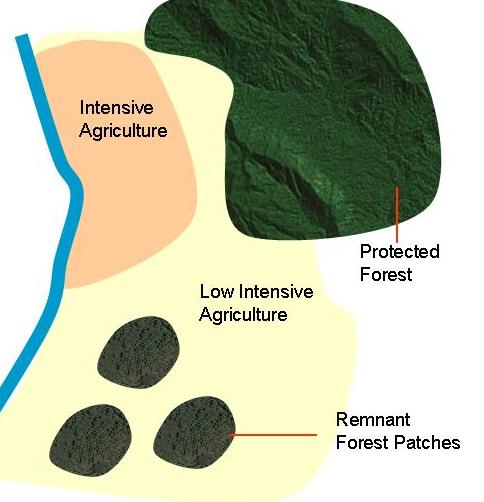
Simple case is a hypothetical example of an fragmented forest
area. The eastern side is bordered by a state forest and the western
side by a river. The area was once occupied by rainforest and is now a
mosaic of remnant forest and farmland. Some of this farmland is
highly productive but some is not and might be available for
reforestation.
Maps: Land uses shown in
figure 1 below.
| Figure 1.
Existing land uses |
Figure 2. Possible options
for forest restoration |
 |
 |
Degradation Issue: The cleared areas are subject to erosion and fragmentation
of the original forest cover has led to threats to current
biodiversity. A landcare group has sufficient resources to restore
100 hectares. What is a cost-effective approach to rehabilitate sites, in particular infrastructure corridors and for the
re-establishment of ecological connectivity?
Decision Context
1. Landowners have contrasting preferences.
The well off landowners are located along the
river and are interested in reforestation to improve river health
and beauty. Others in the cleared agricultural areas are les
well-off and may not be able to afford reforestation.
2. The government
have dual concerns. They want to protect natural areas for wildlife
by connecting forest areas, and they want to improve water quality
in the stream by reducing non-point source pollution from
agriculture.
Restoration Options
Below is a table of planting options.
| Summary of goods
and services provided by different restored forest types |
|
Forest type |
Goods |
Ecological
Services |
| Riparian
|
Biodiversity |
| Natural forest |
Moderate |
High |
High |
| Secondary Forest |
Low |
Moderate |
Moderate |
| Plantation -
short rotation |
High |
Low |
Low |
| Plantation -
multi-species long term |
High |
Moderate |
Low |
(Source: Modified from Lamb, D.
(2005) Scenario modelling to optimize outcomes. In: Restoring Forest
Landscapes, ITTO Technical Series No 23.
International Tropical Timber Organization)
These options may be applied to the
landscape as three scenarios (see figure 2):
1. Riparian strip restoring natural
forest
2. Corridor of natural forest linking
state forest with a remnant patch.
3. Isolating several patches and
allowing secondary forest to re-establish and create a larger patch
4. Consolidating several patches by
planting multi-species plantation with a long rotation period.
Method of Evaluation and Tools
Simplified scenario analysis using an
area weighted score.
GIS multi-criteria analysis. The
options in the table above are translated to scores; 1=Low,
2=Moderate, 3=High. Goods are weighted as 0.5 and Ecological
Services as 0.5. A final score is computed as a linear-weighted
combination.
Results
to be completed....
|