| PhD Title: Integrating Field and Remotely Sensed Data For Assessment of Coral Reef and Seagrass Habitats |
 |
Chris Roelfsema*,
Professor Stuart Phinn*, Dr. James Udy**, Professor Ove Hoegh-Guldberg*** *Centre for Remote Sensing and Spatial Information Science, The University of Queensland, Brisbane, Australia QLD 4072 **Centre for Water Studies, The University of Queensland ***Centre for Marine Studies, The University of Queensland |
|
| Form: Part Time, Commenced: Jan 2004, Confirmed: April 2005, Accepted: September 2009 |
||
Tropical marine ecosystems have an enormous economic, cultural and biological value for the global community (Costanza 1997). Research has proven that these systems are under threat by various human and/or natural impacts and monitoring is needed (UNEP 1992; Wilkinson 2000; Wilkinson 2002). At the second International Tropical Marine Ecosystems Management symposium in Manila, 2003, working groups stated: “Well-designed and targeted research and monitoring programs are essential components of tropical marine ecosystem management to maintain its health.” In the next five to ten years these statements will have the highest priority for the International Coral Reef Initiative. It was further said that all elements of research and monitoring should incorporate the full involvement of, and respect for the range of knowledge and skills available from the whole community: scientists, resource users, indigenous people and members of the general public (ITMEMS2 2003). This PhD proposal will aspire to link remote sensing technologies with community data collection to create effective but low cost monitoring programs. This integration will be beneficial, especially for developing nations.

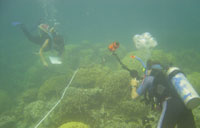

Therefore the aim and objectives of this PhD. proposal are: Research Objectives
To improve coral reef and seagrass habitat mapping capabilities by integrating
low cost remote sensing approaches and field calibration and validation methods.
1. To evaluate the accuracy, cost and perceived relevance of eight commonly
used benthic cover mapping approaches for three different coral reef environments.
2. Conduct a cost-benefit comparison of two field survey methods for calibrating
and validating maps of coral reef benthos derived from high-spatial resolution
satellite images in three different coral reef environments.
3. Identify considerations for comparing the thematic accuracy of multi-use
image based habitat maps in various coral reef environments.